Showing posts with label PER. Show all posts

Wednesday, June 6, 2012

Problem Solving at UNSL

This afternoon I was invited to visit a physics class in mechanics here at the Universidad Nacional de San Luis. The class was working on solving problems using a technique called IDEA, which was adapted from the original methodology which was referred to as GOAL in English.

No matter what you call it, the technique is the same: provide a framework that students can use to solve problems. The relevant steps are:

 I   Información                     G    Gather Information about the problem
D  Desarrollar un plan         O    Organize an approach to solve the problem
E   Ejecutar el plan              A    Analyze the problem
A  Aprender del esfuerzo     L    Learn from your efforts

[pulled from manuscript in development (Benegas & Alarcón) and GOAL]


This was actually the second time that I have seen this methodology in action- I also observed its use as part of the SCALE-UP program when I was in Chile last month. The structure of this class varied a little bit from what I saw in Chile, but the general theme is the same.
 The students all work together in small groups. They use whiteboards or paper to show their work, which they share with their classmates at the end of the period. In SCALE-UP, the group members have rotating responsibilities, which were not present in today's class. Rather, the instructor told me that what usually happens is that each group member has a different colored marker so the contribution of each is readily visible. We didn't have enough markers today for that to happen, but I think it's a great idea.
Another thing that is worth mentioning is the layout of the boards. When I observed Dr. Alcarón in Chile he had taught his students to divide their workspace into 4 equal parts, one for each step of the problem-solving process. I have never gone to this extent with my students before- they just need to separate the sections. The board below from today's session is more what I am used to- the work is shown in an orderly fashion, but without being formally divided into sections. The color-coding helps the different parts stand out. I really liked the boxing of the answers, but then again that's my M.O.
Now, while this ad hoc approach allows for more space to be used to actually solve the problem, there is one serious drawback... it gives short shrift to the final step because students almost always run out of space and don't have enough room left to write down their reflections about the process. I would also like to see a more formal description of where a diagram or sketch goes, but maybe I just feel like this is lacking because I wasn't present for the original discussion that introduced the problem solving process. As my students can attest, I love my diagrams, no matter how poorly drawn they may be!


I also took some videos of the students as they presented. Don't expect any sort of high quality- I have the hands of a sturgeon when it comes to this type of thing! Nonetheless, it should give you an idea of how the discussion process runs in the classroom.


A few caveats: this class wasn't at full strength, apparently there was a concert going on that took its toll on attendance! So the participants may have been the more motivated end of the spectrum. This also isn't what happens in class every day, there seems to be a rotating cycle of class types for each unit. Also, it is college level physics with college students, so it looks a little bit different than a typical high school classroom. That being said, today's material wasn't that much harder than Regents physics, and it was easier than the course I've previously taught in advanced physics. Basically, the conclusions that can be drawn from this class can be applied to high school classes.

I had a god time this afternoon. I learned some new slang and got to interact with students, which has been frustratingly absent from my life here for the past week because of exams and some poor communication. I was also psyched to visit a class that was embracing reformed teaching methods wholeheartedly. I would love to go back and see what their other sessions and labs are like.

Wednesday, May 23, 2012

By popular request

Over the past week I've gotten some feedback from this blog. It was great to hear from folks, both to catch up and hear what people are interested in learning more about. The people have spoken, and they want to see more pictures of teaching and learning. I will do my best to shut my trap and let the images speak for themselves. Some are from a lesson where students used a computer simulation and some are from a lesson I taught using conceptual problems and whiteboards. I am not featured at all- mostly because I was the one shooting, but also because the students are the ones doing the work.


Classes run from 7-3:50 with a lunch break. On select days class goes longer.

Some students brought in laptops to work on a simulation during class.


Hope you enjoyed this, I'll see what I can do to include shots from other classes over the next week or two. If you have any questions feel free to ask them in the comments section and I'll do my best to answer them (or ask someone else who lives locally if I don;t know the answer).

Tuesday, May 22, 2012

No more lectures?

This past week I traveled to Chile using professional development funds from my Fulbright Grant. First I went to to Mendoza, and then caught another bus to Viña del Mar.
Students writing down guiding questions for the unit.
On my first day here we went to visit a school in a remote area called Quillota. I was a little bit apprehensive about visiting this school- I had been told that all of the students had been expelled from other schools and that this was a safety net of sorts. I later learned that they were expelled because of academic problems, no behavior issues. In fact, I found the students to be incredibly nice and open to my presence in the classroom.

Working hard
 At the end we took some pictures together, and the president of the student body (who happened to be in the class I visited), politely asked me if I could send him some pictures to remember my visit. Another thing: this school was basically empty save for desks, a blackboard, and a whiteboard that had seen better days. The room was very cold, way colder than my classroom ever is. Some students wore gloves and hats, and they all had sweatshirts or coats on. Despite these obstacles, the kids worked HARD at what they were doing and seemed really interested in the material. Speaking of which, the instruction was very traditional. I think that the teacher would be open to using different methods, but her lessons and methods seem to be dictated by the school. This seems to be a pattern here, and much of the difficulty in implementing reformed teaching methods lies not in convincing teachers, but in winning over the administration.

Class sizes are small so that the students can receive individualized attention

The entire class with their teacher
I actually came to visit the Universidad Técnica Federico Santa María, which is in Valparaiso, practically next door. Though its name suggests differently, the university is not religiously affiliated. It's one of the top technical schools in Chile, and Hugo Alcarón is leading the charge as the university implements some fantastic reformed teaching methods.
USM is right next to the ocean in picturesque Valparaiso
The first step has been to renovate the classroom environments. Pretty much the only thing they use typical lecture halls for now is to give exams, though these will be utilized for some reformed methods such as Peer Instruction and Interactive Lecture Demonstrations down the road. The new classrooms are beautiful and nearly complete- a few details have yet to be finished, but the system as a whole is impressive.
A SCALE-UP classroom at Penn State. The facilities at USM are similar.
The rooms are designed around the SCALE-UP methodology developed at NCSU, which has also been implemented at the Tecnológico de Monterrey, where Hugo worked previously. The rooms are filled with massive tables that seat nine students (3 groups of 3). The tables are slightly out of round to encourage better collaboration. The tables are to be outfitted with netbooks in the very near future, and students can easily see the output from multiple projectors, which will soon be permanently mounted to the ceilings. The rooms are bright and airy and have terrific views. When we arrived before class started, Hugo had to ask other students who weren't part of the class to leave. More students came to the door during class and turned away, disappointed that the room was being used. Everyone wants to work in these rooms- they're very inviting and have whiteboards and other amenities that go a long way to encourage collaboration. There are multiple classrooms like this, which is a good thing, because ALL of the introductory physics courses are being taught in this manner. Other introductory courses in math, chemistry, and computer science are also being reworked to incorporate reformed teaching methods. Upper division courses are being overhauled as well so that students may eventually graduate without having experienced a single lecture.
Students at USM working in a SCALE-UP classroom
This is an immensely powerful idea, and I am blown away that the university has taken such ambitious steps to improve its students' learning. In fact, a push is beginning to extend these methods to all of the different USM campuses. The commitment that this takes is astounding, but I think it means a lot that the powers that be have recognized that traditional instructional methods simply do not work.

Thursday, March 8, 2012

Something new

This post will hopefully kill two birds with one stone: I want to get down some thoughts that have been percolating so I can go back and check them out before next school year and I thought that they might be of interest to some of y'all, so here goes nothing.

Lately I've been thinking about something called Standards-Based Grading (SBG). The idea is that rather than evaluating students' performance on a given set of assessments, you give them opportunities to demonstrate what they know. They're scored on whether or not they master certain skills, and they can try multiple times to master each skill. Lots of people have been discussing SBG lately, I would recommend reading through the links below if you're interested (I also borrowed most of the images from links these people provided).

http://tinyurl.com/88g3tqo
Think Thank Thunk

Action-Reaction

dy/dan

MeTA musings

Physics! Blog!

Student Perspective


I really like the idea of SBG, but I don't think that integrating it into a Regents course is as easy as snapping your fingers. I think it has to be done carefully and intentionally (and possibly with student input). I envision a grading breakdown that is a combination of traditional scoring and SBG. It might look something like this:

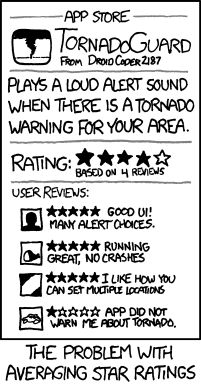
http://xkcd.com/937/


Current:
Class Participation 20%
Homework 25%
Labs 25%
Quizzes 5%
Tests 25%

New:
Class Participation 20%
Labs 25%
Assessments 10%
Performance 45%

By assessments I mean timed problem-solving sessions. I don't like teaching to the test, but I feel that there is a necessity for students to be able to perform under pressure (to a degree) and since the majority are going to be sitting for the NYS Regents Exam in Physics in June, I feel that this element is necessary. It shouldn't be the over-riding factor in their grade, but I think it should play a role. What do you think? Bueller?

I've considered doing away with the separate lab grade... maybe someday. If I were given blocked-ish periods with the same students in class and then lab (or vice-versa) then I could do this more easily. In fact, I would lean toward eliminating the lab report requirement of my class because I would finally have enough time for students to put together meaningful representations of what they're learned. Maybe this last bit is just a fib and I should can it right now... I'll have to think about that. I'm interested to see how Shawn Cornally's collaboration experiment goes: http://shawncornally.com/wordpress/


Emma back when she was a puppy
An idea I had on my morning walk with dog Emma was to let the students determine the breakdown on the first day of class. There would be stipulations: the lab percentage is set in stone, and all of the others have to make an appearance with at least 10%. All of the different sections would have to agree on a common breakdown as well- no willy-nilly bickering about how section placement determined their grade in the course. Maybe this isn't a good tone to set for the year and shows that I'm not in control. Or maybe it's genius in disguise because it shows that by relinquishing control initially, I get students to buy into the system because they made the decisions, thereby gaining more control in the end. And then I will conquer the world! J/K... or am I?

http://tinyurl.com/7t6nnfb

Stay tuned for updates, and if you have an opinion about any of this stuff, leave a comment below!