Showing posts with label Physics. Show all posts

Thursday, June 28, 2012

Argentine Rockets and Quotes

Today I got the chance to see some rocket launches when I visited a school called Normal Mixta. It was really fun to hang out with the students in a more informal setting.


Mounting the rocket onto the launcher

Close-up of the rocket
Troubleshooting a broken pump


All set for launch
I shot some video. Nothing spectacular, but it gives you an idea of what was going on. By the way, I shot one of the videos using the high-speed setting on my camera. Pretty neat.
Normal speed

High Speed

Headed back inside. Notice the unicorn mural- JC that's for you!

Some of the students from Normal Mixta
This afternoon I went to visit a nearby public school. It was my first visit to a true public school, and it was really interesting. I found the students to be very engaging and interested in what I was doing.

Group Photo
Quote of the day: A student in a class I visited today spoke excellent English. After completing my questionnaire, she told me that she wrote in English so it would be easier for me. I was just looking through the results, and two things caught my eye.

First of all, one of my questions is whether or not males anturally tend to be better at physics than females. I was not suggesting that there is a difference, rather I was looking to see what students' impressions were. Next to the question this student wrote "What's wrong with you? Not cool!"  I was thrilled to read this, and can't wait until next week when I can explain my intentions in person.

Also, at the end in the comments section she wrote: "...your Spanish sounds funny but we like you anyway." I'll take it so long as they can understand me and vice versa!

Other notable heartwarming quotes:
"I think that making these tests is a great idea, since nobody thinks about their values anymore (that sucks) and I hope we have another of these tests soon."

"I really like the idea of trying to improve physics education here, because some of my classmates and I find it to be a difficult and tedious subject."

"Welcome to Argentina, I hope that it treats you well and that my questionnaire helps with your project- I am happy to help. Good luck! Take care!"
Emilliano and I

Thanks everyone!

Friday, June 22, 2012

Thank You's

Yesterday I went back to visit Santa Maria. The students were working on problems with accelerated motion, and I enjoyed chatting with them and lending a hand. In case I don't make it back before I leave, I also gave the teacher his parting gift: an I heart NY t-shirt. He was really excited about the shirt and said that it's true, he loves NY! The kids thought this was hilarious since he hasn't been there, and we all got a kick out of it. They'd already received the little trinkets I brought to hand out, and were happy to see their teacher get something too. 
Guillermo showing off his new shirt

We also took a group shot together. The girls were really enthusiastic, as nearly all of the students here have been when I've visited their classes.  

Up close and personal. Not the best shot ever, but at least we're smiling! 
I'm going to talk a little bit about things I've seen at different schools. I'm not going to go into specifics, but some of these things are quite different from what I am accustomed to in the US. I am not trying to say that one system is better or worse than another, just trying to give my loyal readers and idea of what the education here is like.

First of all, every day when a teacher arrives in the classroom they have to fill out the logbook for the class. There is a section for each subject, and the teacher flips to their section and then fills in the day's date and the topic of the class. They have to state whether it is lecture or practicum (I would have so much trouble trying to decide how to code my classes!), and then sign the entry. The idea is that an administrator can check over the logbook to make sure that the teacher covered all of the topics that she was supposed to teach. I am not sure how often this happens, maybe it's like the curriculum mapping that I've done in the past- I don't think that the work I did has ever been used.

There is a difference in the level of equipment that the students have with them in the classroom. I haven't seen any graphing calculators, and many students scramble to borrow calculators from friends before the test starts. However, on the flip side, the students are generally more prepared in terms of having writing utensils, erasers, whiteout, scissors, and glue than their American counterparts, who have been known to show up without even something to write with.

In most schools the physics classes meet twice a week, for about 80 minutes each time. There is some flexibility to this, sometimes it's an 80 minute period and two 40 minute periods. At one school the class only meets once per week. It is rare for a class to have a separate lab period. In the classrooms there is basically no lab equipment, the students have to move to a separate laboratory to do experiments. When computers are needed, students usually bring theirs in from home. Same with cameras... I helped one class use their cell phones to take videos that we used for 2-D analysis of motion with good success, but this took a week's worth of advance planning to pull off.

Classrooms typically have a chalkboard, though a few have whiteboards. It is possible to use a LCD projector, but they have to be reserved ahead of time. It's something we take for granted in the US, but I just had a conversation about using a projector with a class and learned that the deciding factor wasn't the projector, but the screen. The only option is to project the image onto the green chalkboard, and that was rejected. So we're going to use the computer lab instead. This will be my first visit to the computer lab, so I'm excited to see what it's like.

I observed a test being given today. I usually try not to visit on test days because I would rather observe teaching, but we were working through an intermediary and I didn't know it was going to happen. This was an interesting experience. The teacher didn't have any tests to give the students. He asked them to get out sheets of paper, and then dictated the questions to them. This took a good chunk of time, but seemed normal for the students. I suppose it saves on preparation time and copies, but I am not sure that it's the best use of class time. During the test, the students were asking lots of questions. At first the questions were about the problem descriptions, but then they drifted into the realm of "how do I do this problem?" Eventually the teacher announced that no more questions would be answered. I probably would have said that only questions about the descriptions would be answered rather than issue such a blanket statement, but that's just me. It was an eye-opening experience for sure.

In front of a primary school in San Luis. Neat mural!
I've also started recognizing students on the street. It's nice to feel like I finally know more than a handful of people here. I am so ready to see my family again, but at the same time I feel like I'm hitting my stride here. It's hard to feel torn in two directions, but hopefully the teachers will continue what I've started after I leave.

Tuesday, June 19, 2012

you don't want to miss this one

Classic Gosling vehicle, truck model, about to collide with a vulture, which came from Smart Notebook. 

Yesterday I was visiting a school and the teacher invited me to give an example problem. I started off as I always do, with a story, which, like many good stories, was accompanied by a drawing. Now, as those of you who have been my students can attest, my art skills plateaued at roughly a 6th grade level. As such, my drawings are frequently a source of humor for my students. One went so far as to take photos of my terrible drawings as they happened and put together an end-of-the-year slideshow. I'm going to pepper this post with images from earlier this year so you can see for yourselves. Don't be fooled- though the images are chuckle-inducing, there is a deeper theme to come. On a side note, I like to think that my drawings help my students feel better about their own artistic abilities. If nothing else, maybe the artwork helps keep them from falling asleep!

Armadillo, close cousin of the turtle. The dotted line denotes the system we chose in class.
Now my example problem involved cars. I can draw a car or a truck very quickly, but they're not great. In fact, sometimes it's difficult to tell which way the car is supposed to be moving unless I add wind to the back and headlights to the front. But it's what I've got, and I drew it in all its glory in front of a class here, doing my best to explain that I am a horrible artist. Then the funniest thing happened- the students didn't think it was that bad! In fact, they thought it was better than the cars that their own teacher occasionally draws! What are the chances that I would visit the one class in the world with a teacher whose artistic talent is a match for my own? I am sure that he's better than me at animals, which are my biggest downfall. 3-D boxes are my bread and butter, but for some reason I draw more cars, people, and animals than anything else.
Poor fellow stumbling over an extraordinarily massive spiky rock
Anyway, I drew my car and the problem went pretty well. As I was showing the solution the teacher stopped me and explained that he always makes his students solve for the variable in question before substituting, as most good scientists tend to do. I don;t know why I didn't in this case- I'm used to doing so, but I spaced out. Not a good example to set! Anyway, we motored through the example and then the students got to work on a problem of their own.
Duck
I walked around the room and looked over the students' work. I talked with one group about how to convert units when moving from hour*hour to s*s, and then I ended up at the back of the room, where a student was looking lost. I asked her how she was doing, and then we talked about how she might start the problem. I knelt down next to her desk to point something out and she quietly confided to me that she wasn't really any good at physics. I reassured her and said that my own students have difficulty with these sorts of problems, and then we had a discussion about what she needed to find and how she might be able to go about it. We quickly touched on the idea of converting the given numbers to different units, but the bell rang before she was able to really start the problem. I've seen this happen before, and when it does I'm always worried that the next time she goes to start the problem, she'll have lost the train of thought and feel lost all over again.
Dog. I can never get the front legs right, though this poor fellow has other  issues. My rabbits and horses suffer from similar maladies.
In hindsight, I wish I had responded more strongly to her statement about her aptitude for physics. Maybe I was worried about my ability to express myself adequately in Spanish. Maybe I didn't want to draw attention to her and cause her more discomfort. Mainly, I wish I had said more. I should have explained that physics ability isn't something that comes naturally, and that most everyone has to work at it. It just takes some of us longer than others.
Turtle with balloons to reduce the normal force. The R was for his name- Rodney perhaps? He had a twin brother, who didn't have balloons. I make good use of the clone feature of the Smart software.
I remember going to my first national physics teachers conference during my first year teaching at Saranac Lake. It was a big deal for me- I had successfully applied for a grant from the local Teacher's Center to help cover the cost of attending, and I was presenting on the use of a Reflective Writing exercise to help students learn physics. My talk went better than I had expected, despite the scheduling conflict with another talk that seemed to draw most of the potential audience. It actually worked out since what I did during my talk worked out better with fewer people. Anyway, on the way home from Seattle I was stuck in the airport for a couple of hours because of nasty weather. I struck up a conversation with a guy from North Carolina who asked what I'd been in town for. We got to talking and he explained that when he had tried to ask someone else who attended the same conference (you can usually spot the attendees of a physics conference by their nifty bags or clothing), the person he'd asked had blown him off and left to sit with other conference-goers. We ended up having a really good chat, and at the end of the conversation he complimented me on my ability to explain things in a way that made sense, and also thanked me for spending the time to chat with him.  After I returned I told my advisor about the experience, and he was really excited for me. At the time I was just happy that he was proud of me, but lately I've realized that when I look back on that particular conference, that conversation was what stuck with me the most.
Squirrel in a tree (think National Lampoon's X-mas Vacation)
What I'm trying to explain, in a very long-winded and roundabout fashion (how else did you think I was going to generate enough text to justify including all of my pictures???), is that while I am obviously not the physicist out there pushing the boundaries of experimental knowledge, maybe I'm not meant to be. Maybe I'm the teacher who is around to listen to people and answer their questions when nobody else notices. I don't know if I was able to help that student at all, but at least she was able to tell me how she was feeling. I can only hope that the next time I'm put in that situation I'll react more strongly. I think that this experience belies the reason I'm pursuing the line of research I'm working on here- I think that anything that can be done to bolster a student's belief that they have the possibility to succeed is well worth my time and effort. Hopefully my findings will help prepare other teachers to follow my lead.

Wednesday, June 13, 2012

Ask and ye shall receive

Earlier this week I went to visit another school, Colegio San Luis Gonzaga. Like some of the other schools I have visited, it is a private Catholic school for girls. I learned that Gonzaga is the oldest school in the province of San Luis, and it has an excellent reputation. Though I had a great visit this morning, that isn't the topic of this post. Rather, I wanted to comment on the way that my visits have evolved here.

About a week ago I wrote to a friend that I was a little bit frustrated because I hadn't been as successful as I had initially hoped in visiting schools. Soon after I received responses from not one, but two teachers that I had been hoping to work with. I now have a standing invitation to come help out at the university school, and I've been invited to give a physics lesson at Gonzaga next week. There is also talk of having me come visit the English classes to give a presentation as a native speaker, which would be neat too. I spent Monday afternoon at Aleluya helping a teacher with a lesson involving video analysis, which is something I have a lot of experience with. It's a really powerful tool for teaching physics, because the students can capture their own videos and analyze the physics behind them. Talk about a solid connection to physics in the real world!

The Ah-ha moment of the day came when I was meeting with some of the administrators at Gonzaga. We were discussing my project, and they asked what other schools I had visited. I rattled off the short list, and said that I'd been hoping to visit others but it hadn't panned out. The preceptora (I am almost positive that that was her title, but if you happen to be reading this please accept my apologies if I got it wrong) offered to contact her husband, who works at another school here in town. By the time the Director of Gonzaga's secondary school had finished showing me around, she had set up an appointment for the following morning for me to meet her husband and the physics teacher at his school. She also offered to contact any other school that I might be interested in visiting.

My mentor at the university has been great helping me meet local physics teachers, but the ones that he knows seem to be teachers who also work at the university or teachers who have gone through his master's program. There are a load of other schools out there, and I am thrilled to have an "in" so I can get a broader perspective on how physics is taught in the public sector. I am really impressed by the way this worked out. Now all I need to do is kick this sinus infection and I'll be back in business!

Wednesday, June 6, 2012

Problem Solving at UNSL

This afternoon I was invited to visit a physics class in mechanics here at the Universidad Nacional de San Luis. The class was working on solving problems using a technique called IDEA, which was adapted from the original methodology which was referred to as GOAL in English.

No matter what you call it, the technique is the same: provide a framework that students can use to solve problems. The relevant steps are:

 I   Información                     G    Gather Information about the problem
D  Desarrollar un plan         O    Organize an approach to solve the problem
E   Ejecutar el plan              A    Analyze the problem
A  Aprender del esfuerzo     L    Learn from your efforts

[pulled from manuscript in development (Benegas & Alarcón) and GOAL]


This was actually the second time that I have seen this methodology in action- I also observed its use as part of the SCALE-UP program when I was in Chile last month. The structure of this class varied a little bit from what I saw in Chile, but the general theme is the same.
 The students all work together in small groups. They use whiteboards or paper to show their work, which they share with their classmates at the end of the period. In SCALE-UP, the group members have rotating responsibilities, which were not present in today's class. Rather, the instructor told me that what usually happens is that each group member has a different colored marker so the contribution of each is readily visible. We didn't have enough markers today for that to happen, but I think it's a great idea.
Another thing that is worth mentioning is the layout of the boards. When I observed Dr. Alcarón in Chile he had taught his students to divide their workspace into 4 equal parts, one for each step of the problem-solving process. I have never gone to this extent with my students before- they just need to separate the sections. The board below from today's session is more what I am used to- the work is shown in an orderly fashion, but without being formally divided into sections. The color-coding helps the different parts stand out. I really liked the boxing of the answers, but then again that's my M.O.
Now, while this ad hoc approach allows for more space to be used to actually solve the problem, there is one serious drawback... it gives short shrift to the final step because students almost always run out of space and don't have enough room left to write down their reflections about the process. I would also like to see a more formal description of where a diagram or sketch goes, but maybe I just feel like this is lacking because I wasn't present for the original discussion that introduced the problem solving process. As my students can attest, I love my diagrams, no matter how poorly drawn they may be!


I also took some videos of the students as they presented. Don't expect any sort of high quality- I have the hands of a sturgeon when it comes to this type of thing! Nonetheless, it should give you an idea of how the discussion process runs in the classroom.


A few caveats: this class wasn't at full strength, apparently there was a concert going on that took its toll on attendance! So the participants may have been the more motivated end of the spectrum. This also isn't what happens in class every day, there seems to be a rotating cycle of class types for each unit. Also, it is college level physics with college students, so it looks a little bit different than a typical high school classroom. That being said, today's material wasn't that much harder than Regents physics, and it was easier than the course I've previously taught in advanced physics. Basically, the conclusions that can be drawn from this class can be applied to high school classes.

I had a god time this afternoon. I learned some new slang and got to interact with students, which has been frustratingly absent from my life here for the past week because of exams and some poor communication. I was also psyched to visit a class that was embracing reformed teaching methods wholeheartedly. I would love to go back and see what their other sessions and labs are like.

Friday, May 18, 2012

3 Amigos

On the last day of the trip I took around Argentina I went on a tour up into the mountains with a tour group. Not too far, but out of the city. I went rafting and then went through the canopy zipline tour. Canopy is a little bit misleading, because there weren't any tree, but there were ziplines. I was a little bit skeptical beforehand, but it was pretty cool. At least I didn't come down with an infection of flesh-eating bacteria. Anyway, the highlight of the day wasn't either of the activities, though they were great. The highlight was the company of two Argentines from Buenos Aires, a mother and daughter, who were spending the week in Mendoza. We struck up a conversation on the van and they welcomed me as a third wheel for the day (hence the image of the Three Amigos above). They were extraordinarily helpful when I struggled to say something in Spanish, and offered me lots of pointers about how to speak better. We had great conversations and it was a terrific way to spend the day.

One of the biggest Ah-Ha moments I had during the day was when we were watching a vanload of tourists unload. My new friends were talking about where they were from, and eventually agreed that about half were from abroad, some from the US and some from Europe. I asked how they knew, and they explained that it was as simple as complexion right off the bat, but also clothing, sunglasses, baggage, and how they behaved that led them to this conclusion. It turned out that they nailed it- 2 from France, 5 from the US, 4 from Argentina. What I got out of this conversation is that even if I don't open my mouth, most Argentines are going to spot me as a foreigner from a mile away simply by my haircut or the way I dress and walk. So they probably already expect me to speak differently too. This might not seem like much of a revelation, but it was really liberating for me because I don't have to be concerned about fitting in. Not that I ever really expected to blend in to begin with, but now I know it's basically impossible.

Pablo and I sharing a toast before digging into some delicious homemade empañadas. 
The past week or two also marked a big change in my life here in San Luis. It seems I've finally gotten past the awkward outsider phase and found some folks to hang out with, most recently in the form of Pablo and his fiancé Valeria. We've become good friends and they've incorporated me into their daily lives. This has led to all kinds of experiences that I'd been missing out on: cooking meals and eating together, going to the mall and playing air hockey (some things don;t need to be translated), hanging out, and even a soccer match. The game started at midnight, which isn't so common back home, but it was great to play and I can't wait to go again. Pablo has also appointed himself the Mr. Miagi of my Spanish training, and vows that I will return home speaking like a local. Don't get me wrong, the welcome that everyone gave me when I arrived was incredible. However, there is a difference between a formal welcome and making friends on my own. I feel really lucky to have gotten to this level.


My project is moving forward, and I'm slowly getting things in line to visit more schools. The schools I've visited have been great, but I need a wider range of data for my study to be meaningful. It's too bad that some of the schools happen to have their physics classes scheduled at 7:15 on Thursday mornings- I still haven't figured out how to be in two places at the same time. The students are great and I wish I could go to all their classes, but sadly that's not the way it works.


Thursday, March 8, 2012

Something new

This post will hopefully kill two birds with one stone: I want to get down some thoughts that have been percolating so I can go back and check them out before next school year and I thought that they might be of interest to some of y'all, so here goes nothing.

Lately I've been thinking about something called Standards-Based Grading (SBG). The idea is that rather than evaluating students' performance on a given set of assessments, you give them opportunities to demonstrate what they know. They're scored on whether or not they master certain skills, and they can try multiple times to master each skill. Lots of people have been discussing SBG lately, I would recommend reading through the links below if you're interested (I also borrowed most of the images from links these people provided).

http://tinyurl.com/88g3tqo
Think Thank Thunk

Action-Reaction

dy/dan

MeTA musings

Physics! Blog!

Student Perspective


I really like the idea of SBG, but I don't think that integrating it into a Regents course is as easy as snapping your fingers. I think it has to be done carefully and intentionally (and possibly with student input). I envision a grading breakdown that is a combination of traditional scoring and SBG. It might look something like this:

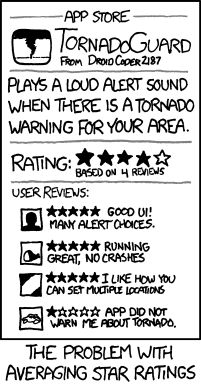
http://xkcd.com/937/


Current:
Class Participation 20%
Homework 25%
Labs 25%
Quizzes 5%
Tests 25%

New:
Class Participation 20%
Labs 25%
Assessments 10%
Performance 45%

By assessments I mean timed problem-solving sessions. I don't like teaching to the test, but I feel that there is a necessity for students to be able to perform under pressure (to a degree) and since the majority are going to be sitting for the NYS Regents Exam in Physics in June, I feel that this element is necessary. It shouldn't be the over-riding factor in their grade, but I think it should play a role. What do you think? Bueller?

I've considered doing away with the separate lab grade... maybe someday. If I were given blocked-ish periods with the same students in class and then lab (or vice-versa) then I could do this more easily. In fact, I would lean toward eliminating the lab report requirement of my class because I would finally have enough time for students to put together meaningful representations of what they're learned. Maybe this last bit is just a fib and I should can it right now... I'll have to think about that. I'm interested to see how Shawn Cornally's collaboration experiment goes: http://shawncornally.com/wordpress/


Emma back when she was a puppy
An idea I had on my morning walk with dog Emma was to let the students determine the breakdown on the first day of class. There would be stipulations: the lab percentage is set in stone, and all of the others have to make an appearance with at least 10%. All of the different sections would have to agree on a common breakdown as well- no willy-nilly bickering about how section placement determined their grade in the course. Maybe this isn't a good tone to set for the year and shows that I'm not in control. Or maybe it's genius in disguise because it shows that by relinquishing control initially, I get students to buy into the system because they made the decisions, thereby gaining more control in the end. And then I will conquer the world! J/K... or am I?

http://tinyurl.com/7t6nnfb

Stay tuned for updates, and if you have an opinion about any of this stuff, leave a comment below!